





loading...

Free shipping for orders above $330.00

How to Wash Organic Cotton Towels

How to Wash Organic Cotton Towels and Keep Them Soft

How to Wash Organic Cotton Towels and Keep Them Soft

How to Wash Organic Cotton Towels and Keep Them Soft

Products and materials selected for how to wash organic cotton towels

Products Used

Products and materials selected for how to wash organic cotton towels

Good organic towel care is less about adding special products and more about protecting the qualities a towel needs to work: open cotton loops, effective rinsing, room to move in the machine and complete drying between uses. Too much detergent, an overloaded drum or a damp pile on the floor can work against softness and absorbency even when the cotton itself is excellent.

The first rule for how to wash organic cotton towels is to read the sewn-in care label. “Organic cotton” identifies the fibre and how it was grown; it does not establish one wash temperature or drying method for every finished towel. Dyes, yarns, hems, weights and manufacturing finishes differ. Follow the towel label, the detergent directions and the washing-machine manual together.

Organic cotton towels are still cotton textiles. They need enough detergent to suspend body oils and soil, enough water and movement for the selected cycle, a proper rinse and thorough drying. The aim is not to avoid washing but to wash accurately. Under-dosing may leave soil behind; over-dosing can make rinsing more difficult. A fixed capful cannot suit every machine, load size, water hardness and detergent concentration.

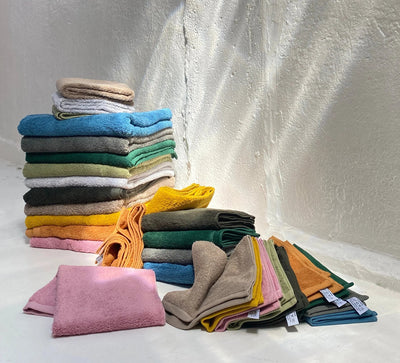
The ZigZagZurich organic towel collection is woven in Portugal from long-staple organic cotton. The product pages describe long, extra-combed loops and a substantial 700 GSM terry construction. Those loops create the plush hand and water-contacting surface, so care should preserve their openness rather than coat, crush or repeatedly overheat them.

Check the label before using or laundering a new towel. If it instructs you to wash before first use, follow the stated cycle. Remove packaging and detachable items, but do not cut the permanent care label. Inspect the towel for pulled loops, marks or damage so that a product issue is not confused with later laundry wear.

New cotton towels can release some loose surface fibres during early washes. This linting is not automatically a defect and often decreases as loose fibres are removed. Clean the appliance filter or lint screen as directed by its manufacturer, and avoid washing the new towel with clothing that readily attracts lint.

Colour transfer is also most likely to be noticed in early cycles. Sort light, medium and dark colours according to their labels and your normal laundry practice. Do not assume that an OEKO-TEX® certification or an organic fibre claim means every dye can be washed with whites.
Explore Collections

How to Wash Organic Cotton Towels and Keep Them Soft

Sorting towels without creating a tiny load for every colour

Read the care label. Confirm permitted temperature, cycle, bleach symbols and drying method.

Sort the load. Separate incompatible colours and keep towels away from zips, hooks and abrasive fastenings that can catch loops.

Check the drum. Leave enough room for the textiles to lift, move and rinse according to the machine manual.

Dose detergent accurately. Follow its label for machine type, load size, soil level and water hardness.

Select the labelled cycle. Do not raise the temperature simply because the item is a towel.

Remove promptly. Shake each towel open and begin the permitted drying method without leaving it compressed while wet.

Dry fully. Store or reuse only when the whole towel, including hems, is dry.

Sorting protects colour and surface. New, deeply coloured towels deserve particular care until you understand how they behave. Whites and very pale textiles should not share a first wash with saturated shades. Later, compatible colours can often be grouped when their care labels, cycle requirements and lint behaviour agree.

Also sort by construction and hardware. Open terry loops can catch on exposed zips, hook-and-loop tape, bra hooks or sharp trims. A towel load does not have to contain towels only, but everything in it should be compatible in colour, temperature, cycle and surface. Close permitted fastenings and place snag-prone items elsewhere.

A half-empty drum is not automatically more effective, and a tightly packed drum is not efficient. Use the washing-machine maker’s capacity guidance. Dense 700 GSM towels hold considerable water and become much heavier when saturated; count the load by what the appliance can wash and rinse properly, not by how many dry pieces can be pushed inside.

Use the detergent manufacturer’s measured dose for the actual conditions. Concentrated liquid, powder, sheet and capsule products do not have interchangeable quantities. The correct amount changes with load, soil, machine type and water hardness. “Use less” is incomplete advice if it leaves body oils behind; “add extra” is equally poor if the rinse cannot remove it.

Residue from inaccurate dosing or poor rinsing can make the surface feel less fresh or less open. If towels repeatedly emerge stiff, heavy, slippery or strongly perfumed, review the dose, drum loading and machine programme before buying another additive. Check whether the dispenser and machine need maintenance under the appliance manual.

Fabric softener, fragrance and towel absorbency

Do not pour concentrated detergent directly onto a dry coloured towel unless the detergent label specifically instructs this as a pretreatment. For a stain, identify it and use only a product and method allowed by the towel’s care label. Never mix bleach, acids, ammonia or other laundry chemicals.

There is no responsible universal answer such as “always wash organic cotton towels at 40°C” or “towels must be washed at 60°C.” The maximum shown on the care label is not necessarily the temperature required for every ordinary wash, and a higher setting can affect colour, energy use and textile wear. Select a permitted temperature that suits the soil and hygiene context.

If illness, contamination or a special hygiene requirement changes the task, follow appropriate local health guidance as well as the product and appliance instructions. Do not improvise a hot cycle or disinfectant combination that the towel label does not allow. When in doubt, ask the product maker.

The same caution applies to bleach. White cotton is not automatically bleach-safe, and coloured organic cotton should never be treated from fibre name alone. Read the triangle symbols, the product instructions and the bleach label before use.

Fabric conditioners work by depositing softening ingredients on fibres. Formulations and labelled uses vary, so one statement cannot cover every product. For an absorbent towel, avoid automatic or excessive use. If the towel label says not to use softener, do not use it. If both labels permit it, follow the additive dose rather than pouring by eye and monitor how the towel performs.

More fragrance is not evidence of a cleaner towel. Scent boosters and multiple additives increase the number of substances that must be dispersed or rinsed. Start with the simplest routine that cleans effectively. If skin sensitivity is a concern, choose suitable products on professional advice and follow their instructions instead of creating an untested home mixture.

If a towel appears to have lost absorbency, first rule out incomplete drying, overloading, incorrect detergent dose and additive buildup. Rewash according to the care label with correctly measured detergent and a suitable rinse. Do not combine internet remedies such as vinegar, bicarbonate and bleach: mixtures can be ineffective, damage materials or create a safety hazard.

Fabric softener, fragrance and towel absorbency
ZigZagZurich

ZigZagZurich

A design perspective on how to wash organic cotton towels

Explore artist

FROM THIS ARTIST / ZZ RECOMMENDATIONS

Softness lasts when absorbency remains the priority

Wash according to use rather than a rigid calendar. For ordinary personal bath use, several uses may be possible when the towel dries completely; wash sooner after heavy soiling, shared use, persistent dampness or any hygiene concern. Sort, dose and load deliberately, then dry fully before returning towels to the shelf.

Review the whole rotation. Inspect hems and loops, separate any damaged towel before it snags further, clear appliance filters and clean dispensers as the machine manual requires. Check whether shelves are overcrowded or poorly ventilated. If only one towel repeatedly feels stiff or smells musty, compare its label, size and drying position before changing every laundry setting.

The Marble Grey organic cotton towel is a concrete ZigZagZurich example: 100% organic cotton, 700 GSM, extra-combed loops, double-stitched hems and Portuguese weaving. That substantial construction rewards space in the washer and an open drying position. These specifications describe the product; its own care label still controls temperature and drying.

GSM describes grams per square metre, not a universal washing programme. A denser towel contains more textile mass over the same area and can hold more water in use and in the machine. Consult the towel GSM guide when choosing weight, then adapt the laundry load and drying space to the actual towel.

A soft towel is not one coated with the most products. It is clean, well rinsed, able to dry completely and handled within its labelled limits. Protect that balance by measuring detergent, leaving the drum enough working space, choosing only permitted additives and opening the textile immediately after washing.

Build care around the finished towel rather than a generic fibre rule. The label defines temperature and drying; your water, machine and routine determine the appropriate dose and load. With those variables under control, long-staple organic cotton terry can retain the open, tactile surface that makes it comfortable and useful every day.

YOUR CART IS EMPTY